
Common Salesforce Deployment Mistakes (And How to Fix Them)
Many Salesforce deployment mistakes do not appear during deployment — they appear after release.
A deployment may complete successfully, but users still encounter issues such as missing configurations, broken layouts, or inconsistent permissions.
This happens because deployment is only one part of the release lifecycle. Without a structured approach, gaps in the process lead to problems in production environments.
What Causes Salesforce Deployment Mistakes
Salesforce deployments become complex as systems scale across multiple environments and teams.
Common causes include:
- Manual processes
- Lack of standardized workflows
- Environment inconsistencies
- Missing validation steps
These issues create gaps between environments, making it difficult to ensure consistent behavior after release.
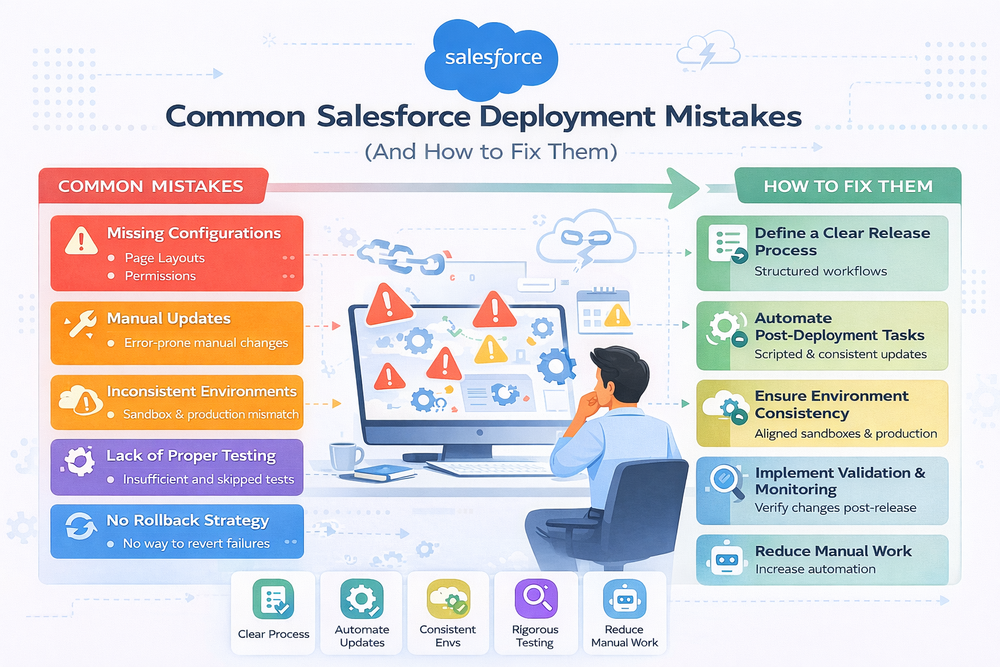
Most Common Salesforce Deployment Mistakes
Missing Configurations
One of the most common Salesforce deployment mistakes is missing configurations after deployment.
Salesforce does not automatically overwrite all components, especially subscriber-controlled elements such as page layouts, permissions, and custom settings.
As a result, production environments may behave differently than expected.
Ignoring Post-Deployment Steps
Many teams consider deployment the final step, but critical work still remains after changes are delivered.
Post-deployment activities such as updating layouts, validating permissions, and syncing configurations are essential for system stability.
A detailed breakdown of this stage can be found here
Inconsistent Environments
Over time, sandbox and production environments drift apart.
Differences in metadata, configurations, and data structures lead to unexpected behavior after deployment.
This issue becomes significantly more complex when working with multiple orgs.
Manual Updates After Deployment
Many teams rely on manual fixes after deployment to resolve issues.
This approach is inefficient, error-prone, and difficult to scale.
Bulk operations and automated updates provide a more reliable alternative
Lack of Proper Testing
Testing is often limited to basic validation rather than full scenario-based verification.
Teams may rely only on unit tests without testing real business processes.
Salesforce recommends comprehensive testing strategies
Without proper testing, issues surface only after deployment.
No Rollback Strategy
Another critical mistake is the absence of a rollback plan.
When deployment issues occur, teams must be able to quickly revert changes or restore previous states.
Validation and rollback strategies are essential for safe releases
Overreliance on CI/CD
CI/CD tools improve deployment efficiency, but they do not fully solve release challenges.
They focus on delivering changes, but they do not manage post-deployment processes or ensure environment consistency.
The difference is explained in detail here
How to Fix Salesforce Deployment Mistakes
Define a Structured Release Process
A clear release process ensures that every stage — from development to post-deployment — is properly managed.
A complete workflow is outlined here
Automate Post-Deployment Tasks
Manual updates should be replaced with automated processes wherever possible.
Automation ensures consistency, reduces human error, and improves scalability across environments.
Ensure Environment Consistency
Keeping environments aligned is critical.
This includes synchronizing configurations, permissions, and metadata across all environments.
Consistent environments reduce unexpected behavior after release.
Implement Validation and Monitoring
Validation should continue after deployment.
Teams must verify that changes work correctly in production and monitor system performance over time.
Reduce Manual Work
Manual processes do not scale effectively.
By reducing manual intervention and increasing automation, teams can improve reliability and efficiency.
How Deployment Mistakes Scale with Complexity
Deployment issues grow as systems become more complex.
- In a single-org environment, issues are manageable
- In multi-org setups, inconsistencies increase
- At scale, manual processes become unsustainable
Automation and structured workflows become essential for maintaining control.
Tools That Help Prevent Deployment Mistakes
Native Salesforce Tools
Salesforce provides tools such as Change Sets and the Metadata API.
While useful, they have limitations in complex environments and large-scale deployments.
CI/CD Solutions
CI/CD tools automate deployments and improve speed.
However, they primarily focus on delivery rather than post-deployment operations.
Post-Deployment Automation Tools
Post-deployment tools focus on ensuring that changes work correctly after release.
They help manage updates, validate configurations, and maintain consistency across environments.
How ZuppIO Helps Avoid Deployment Mistakes
ZuppIO is designed to address gaps that occur after deployment.
It helps teams:
- Automate updates across multiple environments
- Execute scripts at scale
- Maintain consistent configurations after deployment
By extending automation beyond deployment, ZuppIO helps ensure that releases are predictable and reliable.
Conclusion
Most Salesforce deployment mistakes are not caused by technical failures, but by gaps in the process.
When teams focus only on deployment, they overlook critical steps required to ensure system stability.
A complete release lifecycle — including post-deployment — is essential for reducing errors and scaling operations effectively.
What are Salesforce deployment mistakes?
Salesforce deployment mistakes are issues that occur when changes are not fully applied, validated, or synchronized across environments. These problems often appear after deployment rather than during it.
Why do Salesforce deployments fail?
Deployments typically fail due to missing configurations, inconsistent environments, lack of testing, and incomplete post-deployment processes. These gaps lead to unexpected behavior in production.
How can deployment mistakes be avoided?
Deployment mistakes can be avoided by implementing a structured release process, improving testing practices, automating post-deployment tasks, and ensuring environment consistency.
What happens after deployment in Salesforce?
After deployment, teams must validate changes, update configurations, synchronize environments, and monitor system behavior to ensure everything works as expected.