
Salesforce Release Coordination Across Multiple Environments
Salesforce release coordination across multiple environments is one of the most challenging aspects of managing a modern Salesforce ecosystem.
In practice, most organizations operate several Salesforce environments simultaneously. These environments typically include:
- development orgs
- sandbox testing environments
- staging environments
- production environments
- subscriber or customer orgs
Because of this structure, coordinating releases across environments becomes more than a simple deployment task. Instead, it turns into a broader operational coordination challenge.
Without proper Salesforce release coordination, teams often experience several problems. For example:
- inconsistent configurations
- partial releases across environments
- integration failures
- unexpected production incidents
As environments evolve independently, synchronization becomes increasingly difficult. Consequently, teams must implement structured release coordination processes.
For a deeper explanation of the operational challenges behind Salesforce releases, see our article on Salesforce Release Management Challenges.
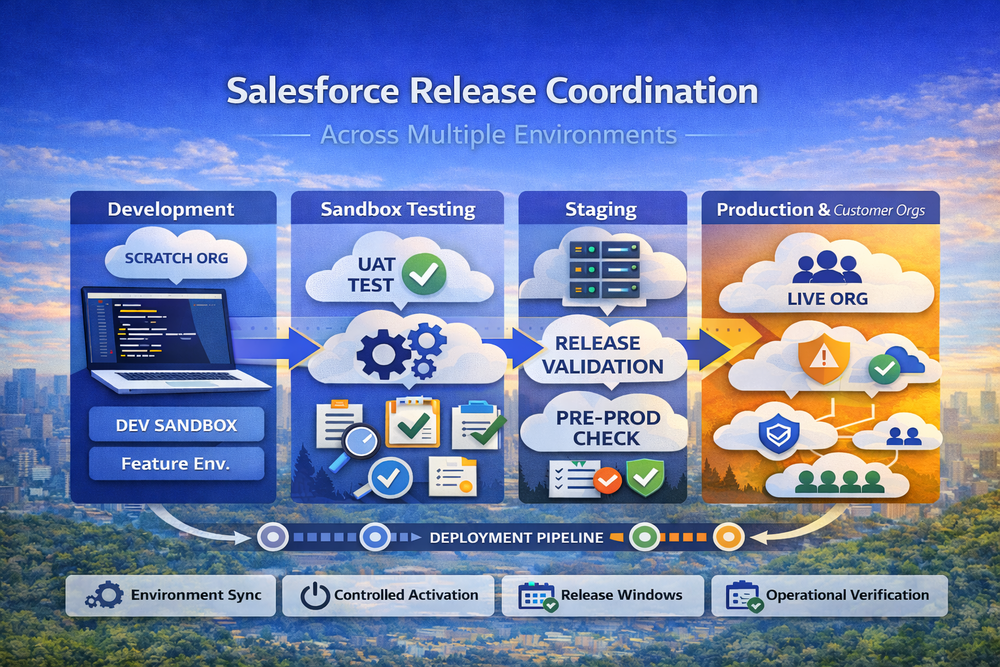
Why Salesforce Release Coordination Across Multiple Environments Is Difficult
Although Salesforce environments may originate from the same production instance, they rarely remain identical over time.
Gradually, environments begin to diverge due to:
- configuration changes
- permission updates
- automation adjustments
- integration configuration differences
- data variations
As a result, a deployment that behaves correctly in one environment may behave differently in another.
Salesforce recommends adopting structured DevOps practices to manage these complexities.
You can learn more about these practices in the official Salesforce DevOps documentation.
However, DevOps pipelines mainly address deployment automation. They do not fully solve the problem of coordinating operational changes across multiple environments.
Salesforce Environments in Multi-Environment Release Coordination
In most organizations, Salesforce operates across several environments that support different stages of the development and release lifecycle. These environments help teams safely build, test, and validate new functionality before it reaches production.
Typically, the environment structure includes development orgs, testing sandboxes, staging environments, and production environments. Each stage plays a specific role in ensuring that releases are stable and predictable.
However, coordinating releases across these environments requires careful planning. As environments evolve independently, differences in configuration, permissions, and integrations can introduce unexpected behavior. Therefore, Salesforce release coordination becomes essential to maintain consistency across the entire ecosystem.
Development Environments
Development environments represent the first stage of the release lifecycle.
At this stage, developers build features and configure automation. These environments often include:
- scratch orgs
- developer sandboxes
- feature development environments
Developers validate early functionality before promoting changes further in the release pipeline.
Salesforce provides tools such as DevOps Center to manage these development workflows.
Nevertheless, development environments rarely contain production-level complexity.
Sandbox Testing Environments
Sandbox environments support testing under more realistic conditions.
For instance, teams use sandboxes for:
- integration testing
- user acceptance testing
- workflow validation
Compared to development environments, sandboxes contain larger datasets and more complete automation configurations.
Salesforce provides detailed documentation about Salesforce sandbox environments.
Even so, sandbox environments may still differ from production in subtle ways.
Staging Environments
Staging environments represent the final validation stage before production deployment. At this stage, teams attempt to simulate production conditions as closely as possible.
In staging, teams typically verify:
- deployment procedures
- integration connectivity
- automation behavior
- user permissions and access
Because staging environments mirror production more closely than other environments, they help identify potential issues before the release reaches live users.
Nevertheless, staging environments are still only an approximation of production. As a result, teams must combine staging validation with strong release coordination practices to reduce operational risks.
Production and Subscriber Environments
Finally, production environments handle real business operations.
In simple setups, production consists of a single Salesforce org. However, in larger ecosystems production may include:
- multiple production orgs
- regional Salesforce instances
- partner environments
- subscriber orgs
For example, Salesforce ISVs may maintain hundreds of subscriber environments.
Managing updates across these environments often requires automation tools such as Mass Package Install and Upgrade.
Without coordinated release processes, maintaining consistency across large Salesforce landscapes becomes extremely difficult.
Common Problems Without Salesforce Release Coordination
Without proper Salesforce release coordination, organizations often experience operational instability during releases.
For example, environments may receive updates at different times, which creates inconsistent system behavior. In addition, configuration drift between environments may introduce unexpected issues during deployment.
Common problems include:
- incomplete releases across environments
- configuration differences between orgs
- integration failures during activation
- automation conflicts after deployment
As Salesforce ecosystems grow larger, these problems become more frequent. Consequently, organizations must adopt structured release coordination strategies to maintain stability.
Partial Releases Across Environments
First, environments may receive updates at different times.
As a result, some environments operate with new configurations while others still run older versions.
To address this issue, teams often rely on automation tools such as Mass ZIP Deploys.
These tools help distribute metadata updates across multiple orgs more consistently.
Configuration Drift
Another common issue is configuration drift.
Over time, administrators modify different environments independently. For example, they may adjust:
- permissions
- page layouts
- automation rules
- workflows
Consequently, environments gradually diverge.
Tools such as Mass Post-Install Updates help synchronize subscriber-editable components.
Integration Failures
In addition, Salesforce environments frequently connect to external systems.
Typical integrations include:
- ERP platforms
- marketing automation tools
- payment systems
- internal APIs
Salesforce provides guidance on building reliable integrations in its Salesforce integration architecture documentation.
However, when releases are poorly coordinated, integrations may reconnect at different times and cause unexpected failures.
Operational Instability After Deployment
Finally, many Salesforce issues occur after deployment rather than during it.
During the activation phase several processes occur simultaneously:
- sharing rules recalculate
- automation workflows execute
- scheduled jobs run
- integrations reconnect
- users interact with the system
Consequently, previously hidden issues may appear.
To mitigate these risks, teams may use tools such as Validation and Revert.
Key Principles of Salesforce Release Coordination
Effective Salesforce release coordination is based on several operational principles that help teams maintain consistency across environments.
These principles ensure that releases are not only deployed successfully but also activated safely across all environments.
Organizations that follow these principles are better able to reduce deployment risks, avoid configuration drift, and maintain stable production systems.
Key coordination practices include environment synchronization, controlled activation, structured release windows, and operational verification after deployment.
Environment Synchronization
First, environments should remain synchronized before deployment.
This includes aligning:
- package versions
- configurations
- permissions
- layouts
Organizations managing multiple environments often use Mass Access Request Across Salesforce Orgs.
Controlled Activation
Controlled activation allows teams to gradually enable changes after deployment rather than activating everything at once.
Instead of immediately exposing new configurations to all users and integrations, teams coordinate the activation of automation, workflows, and external integrations. This staged approach helps reduce the risk of cascading failures across the system.
Controlled activation is particularly important in complex Salesforce environments where multiple integrations, scheduled jobs, and automation processes interact with each other.
Release Windows
Release windows define scheduled periods when production deployments are allowed.
During these windows, teams perform releases while monitoring system behavior closely. This approach provides time to verify integrations, automation processes, and user workflows before the system resumes normal operations.
Release windows also help organizations coordinate releases across multiple environments and teams. As a result, they reduce unexpected downtime and improve operational stability.
Operational Verification
Operational verification takes place immediately after deployment. During this stage, teams confirm that the system behaves correctly in real production conditions.
Verification typically includes checking:
- user permissions
- automation workflows
- integration connections
- critical business processes
By validating these elements early, teams can quickly detect issues and respond before they affect a larger number of users.
Operational verification therefore plays a crucial role in successful Salesforce release coordination.
Why CI/CD Does Not Solve Salesforce Release Coordination
CI/CD pipelines play an important role in Salesforce development.
They automate:
- build processes
- testing pipelines
- deployment automation
Many organizations integrate pipelines with Salesforce using CI/CD integration tools.
Nevertheless, CI/CD pipelines primarily focus on delivering metadata changes.
They do not coordinate:
- environment readiness
- operational activation
- cross-org synchronization
Therefore, organizations must combine CI/CD with additional release coordination processes.
Conclusion
Salesforce release coordination across multiple environments ensures that all environments reach a stable operational state at the same time.
As Salesforce ecosystems grow, deployment automation alone becomes insufficient.
Effective release coordination combines:
- deployment automation
- environment synchronization
- controlled activation
- operational verification
Together, these practices help organizations maintain stable Salesforce operations at scale.
For more insight into operational risks behind Salesforce releases, read our article on Salesforce Release Management Challenges.
What is Salesforce release coordination?
Salesforce release coordination is the process of managing deployments across multiple Salesforce environments to ensure that updates are delivered consistently and that systems remain stable after deployment. It involves synchronizing environments, validating integrations, and coordinating activation of automation and user access.
Why is Salesforce release coordination important?
Salesforce release coordination is important because modern Salesforce ecosystems often include multiple environments such as development, sandbox, staging, and production. Without coordination, deployments can create configuration drift, integration failures, and inconsistent behavior across environments.
What environments are typically involved in Salesforce releases?
A typical Salesforce release process involves several environments, including development orgs, sandbox testing environments, staging environments, and production environments. Each environment plays a specific role in validating changes before they are deployed to live users.
Is CI/CD enough for Salesforce release coordination?
CI/CD pipelines automate build, test, and deployment processes. However, they do not fully coordinate environment readiness, automation activation, or cross-org synchronization. Therefore, organizations often combine CI/CD pipelines with additional release coordination processes.
What are the biggest risks during Salesforce releases?
The biggest risks often occur after deployment during the activation phase. At that moment automation runs, integrations reconnect, sharing rules recalculate, and users begin interacting with the system. Without proper coordination, these processes can create unexpected production issues.
How do organizations manage releases across multiple Salesforce orgs?
Organizations typically manage multi-org Salesforce releases by combining deployment automation, environment synchronization tools, structured release windows, and operational verification processes. These practices help ensure consistent behavior across environments.