
Why Salesforce Deployment Challenges Still Exist (Even with DevOps Tools)
Salesforce deployment challenges still exist even in teams that use modern DevOps tools.
Many organizations have adopted CI/CD pipelines, version control, and automated deployments. On paper, everything looks mature and structured. However, production issues continue to appear after releases.
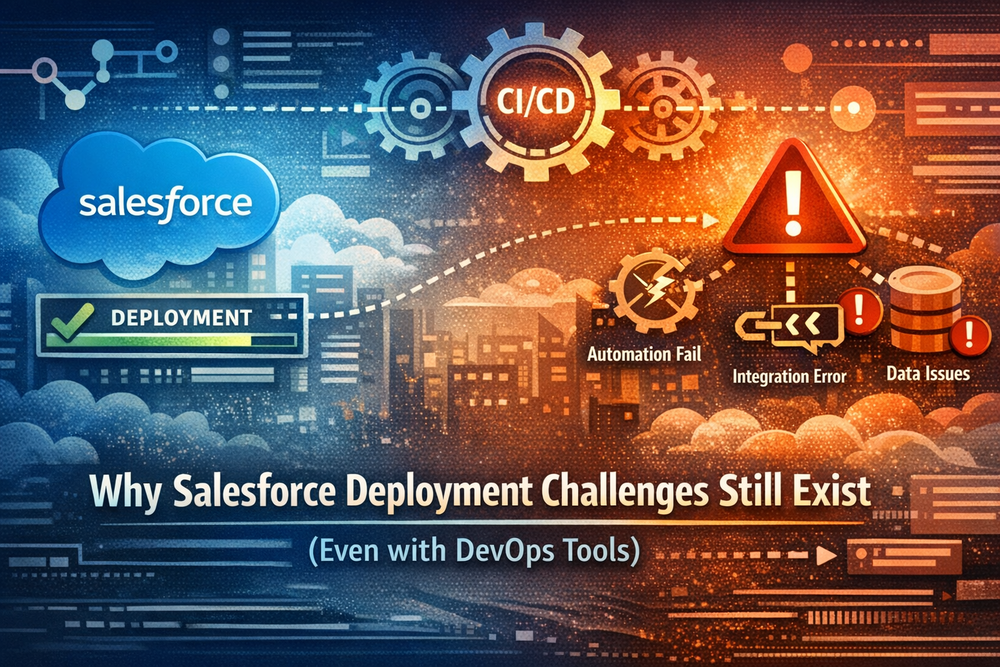
The reason is simple: DevOps improves how changes are delivered, but not how the system behaves after deployment.
What DevOps Solves in Salesforce
DevOps has significantly improved how Salesforce teams manage deployments.
Version Control
Teams use Git to:
- track changes
- manage versions
- collaborate across teams
This reduces conflicts and improves transparency.
CI/CD Pipelines
CI/CD enables:
- automated deployments
- repeatable release processes
- faster delivery cycles
This reduces manual work and human error during deployment.
Deployment Validation
DevOps tools validate:
- metadata integrity
- dependencies between components
- deployment success
As described in the Salesforce DevOps Center overview, these tools focus on managing and delivering changes across environments.
Conclusion: DevOps makes deployment faster, safer, and more predictable.
What DevOps Does NOT Solve
Despite these improvements, key Salesforce deployment challenges remain.
Post-Deployment Behavior
After deployment:
- automation executes updated logic
- flows and triggers behave differently
- system behavior changes
DevOps tools do not control how the system behaves under real conditions.
Configuration Drift
Over time:
- environments become inconsistent
- configurations diverge
- orgs behave differently
This is especially critical in multi-org setups.
Data Reality
Sandbox environments differ from production:
- data volumes are smaller
- edge cases are missing
- historical data behaves differently
This leads to unexpected issues after deployment.
Integration Dependencies
External systems depend on:
- field structures
- APIs
- permissions
Even small changes can break integrations.
Key insight:
DevOps validates delivery — not real system behavior.
The Core Problem: Metadata vs Reality
Salesforce deployments are based on metadata.
However, the system itself operates on:
- data
- configuration
- runtime interactions
This creates a gap.
As explained in Salesforce architecture fundamentals, metadata defines structure — but behavior depends on how the system runs in real conditions.
Key insight:
Salesforce works as a system, not just as metadata.
Why Salesforce Deployment Challenges Still Exist
Even with DevOps, challenges persist because:
- systems are complex
- automation interacts with real data
- environments are not identical
- integrations introduce dependencies
These factors create issues that DevOps tools are not designed to solve.
For a deeper look, see
what happens after deployment in Salesforce
and
limitations of Salesforce deployment tools
Real Example
A typical scenario:
- CI/CD pipeline completes successfully
- deployment passes validation
- release is marked as successful
Then:
- automation runs with real data
- unexpected conditions are triggered
- records are updated incorrectly
From a deployment perspective, everything worked.
From a business perspective, the system failed.
The Missing Layer in Salesforce DevOps
There is a gap between deployment and real system behavior.
Post-Deployment Layer
This layer includes:
- automation control
- configuration updates
- cross-org consistency
- runtime validation
This is where most Salesforce deployment challenges occur.
Why This Matters for Teams
Without managing this layer, teams face:
- production risks
- inconsistent environments
- manual fixes
- delayed releases
Over time, these issues slow down growth and increase operational complexity.
How ZuppIO Fits Into This Gap
ZuppIO complements DevOps by focusing on what happens after deployment.
It helps teams:
- automate post-deployment updates
- synchronize configurations across orgs
- execute changes across environments
- validate and safely revert updates
For example:
- post-install updates across multiple orgs
- execute anonymous Apex in Salesforce
- validation and revert in Salesforce
ZuppIO does not replace DevOps.
It extends it into the post-deployment phase.
Final Thoughts
DevOps has transformed how Salesforce teams deliver changes.
But it does not eliminate Salesforce deployment challenges.
Because:
- deployment success ≠ system success
- metadata ≠ behavior
- delivery ≠ reliability
The real challenge is not deploying changes — it is managing how the system behaves after deployment.
Why do Salesforce deployment challenges still exist?
Salesforce deployment challenges still exist because DevOps tools focus on delivery, not runtime behavior. Issues appear when automation, data, and integrations interact in production.
Does DevOps solve Salesforce deployment problems?
DevOps improves deployment processes, but it does not fully solve post-deployment challenges related to system behavior and data.
What does DevOps not cover in Salesforce?
DevOps does not fully cover post-deployment behavior, data-related issues, configuration drift, and integration dependencies.
Why is metadata not enough in Salesforce deployments?
Metadata defines structure, but system behavior depends on real data, user actions, and runtime conditions.
What is missing in Salesforce DevOps?
The missing part is the post-deployment layer — automation and control over what happens after deployment.