
Salesforce Deployment Challenges: Common Problems and Solutions (2026 Guide)
Salesforce deployment challenges are one of the most common issues teams face when managing releases across environments. While modern tools make deployment faster and more structured, they do not eliminate the complexity of Salesforce systems.
As described in the official Salesforce DevOps overview, deployment is only one part of the release process and does not guarantee system stability after changes are delivered.
In many cases, a deployment is technically successful — but the system still does not behave as expected.
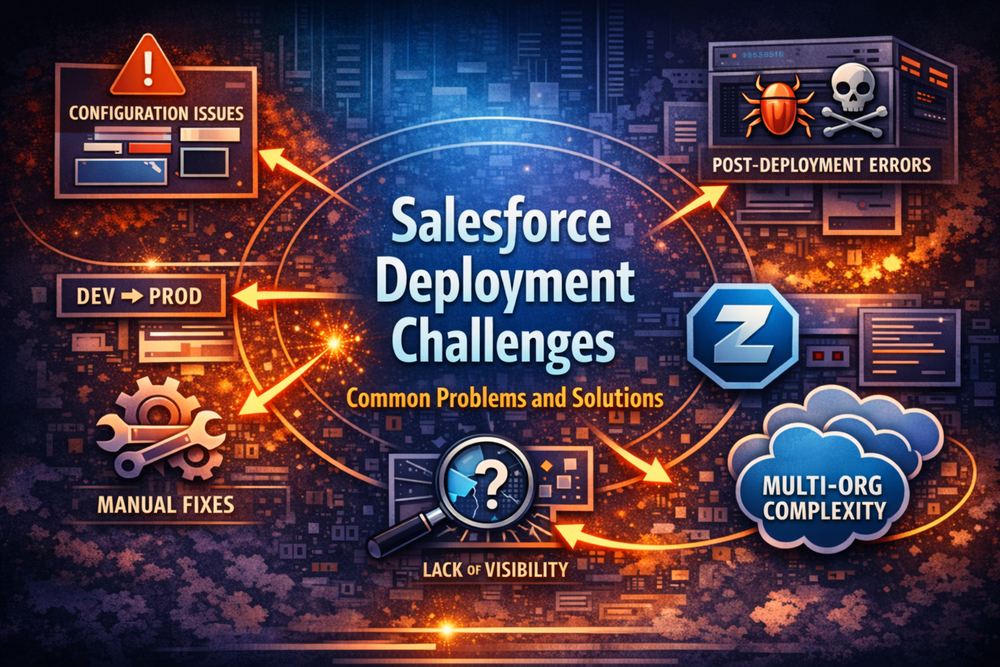
What Are Salesforce Deployment Challenges?
Salesforce deployment challenges refer to the problems teams encounter when moving changes from one environment to another and ensuring those changes work correctly in production.
These challenges typically appear:
- during deployment
- immediately after release
- or even hours later
For a broader understanding, you can explore this complete guide to Salesforce deployment tools and DevOps solutions.
Most Common Salesforce Deployment Challenges
Configuration Issues After Deployment
One of the most frequent problems is related to configuration.
After deployment:
- layouts may not reflect changes
- picklists may be inconsistent
- permissions may not apply correctly
- record types may behave differently
This happens because deployment tools primarily move metadata — not the full system state.
Environment Differences
Salesforce environments are rarely identical.
Differences between sandbox and production include:
- data variations
- configuration changes
- user roles and permissions
This leads to environment drift, a well-known issue explained in Salesforce environment management best practices.
Manual Post-Deployment Work
Many teams rely on manual steps after deployment:
- updating permissions
- adjusting layouts
- running scripts
- validating changes
This process is time-consuming and error-prone, especially in complex environments.
Lack of Visibility
After deployment, teams often lack visibility into:
- what actually changed
- what failed silently
- what needs to be fixed
This makes troubleshooting slow and reactive.
Multi-Org Complexity
For organizations working with multiple Salesforce orgs, deployment challenges increase significantly.
Teams must:
- apply changes across multiple environments
- ensure consistency between orgs
- manage different configurations
This is especially relevant for ISVs and enterprise teams.
Why Salesforce Deployment Challenges Happen
Metadata vs Configuration Gap
Deployment tools move metadata, but Salesforce behavior depends heavily on configuration.
This creates a gap between:
- what is deployed
- what actually works
System Complexity
Salesforce includes:
- automation (flows, triggers)
- integrations
- background jobs
- user interactions
All of these can be affected after deployment.
Lack of Post-Deployment Processes
Most teams do not have a structured process for what happens after deployment.
As a result:
- issues are discovered too late
- fixes are applied manually
- systems become inconsistent
What Happens After Deployment
Many challenges appear not during deployment, but after it.
After a release:
- automation starts running
- integrations reconnect
- users interact with new configurations
At this stage, issues begin to surface.
You can explore this deeper in the article about limitations of Salesforce deployment tools.
The Gap Between Deployment and System Readiness
A key insight is:
A successful deployment does not guarantee a working system.
Deployment tools focus on delivery — not system behavior.
How Teams Can Reduce Deployment Challenges
To minimize issues, teams need to:
- standardize environments
- reduce manual work
- improve visibility
- introduce automation beyond deployment
Teams that adopt structured release processes typically reduce risk and improve stability.
Extending Beyond Deployment with ZuppIO
ZuppIO helps teams handle Salesforce deployment challenges by adding an operational layer on top of deployment processes.
It enables teams to:
- automate post-deployment updates
- synchronize configurations across orgs
- execute changes at scale
- validate and revert operations
For example, teams can automate post-install updates across multiple orgs.
They can also run deployments and updates using mass ZIP deploys in Salesforce.
And safely control releases using validation and revert in Salesforce.
Final Thoughts
Salesforce deployment challenges are not just technical issues — they are a result of system complexity and gaps in the release process.
While deployment tools are essential, they solve only part of the problem.
The real challenge is ensuring that the system works correctly after deployment.
What are Salesforce deployment challenges?
Salesforce deployment challenges are issues that occur when moving changes between environments or after deployment, including configuration mismatches and system inconsistencies.
Why do Salesforce deployments fail even when successful?
A deployment can be technically successful but still cause issues due to configuration gaps, automation behavior, or environment differences.
What causes configuration issues after deployment?
Configuration issues occur because deployment tools move metadata but do not automatically update layouts, permissions, or system settings.
How do multi-org environments increase deployment challenges?
Multiple orgs introduce complexity because each environment may have different configurations, making consistency harder to maintain.
How can teams reduce Salesforce deployment challenges?
Teams can reduce challenges by standardizing environments, automating post-deployment processes, and improving system visibility.