
Top Salesforce Release Management Challenges in Multi-Environment Teams (2026)
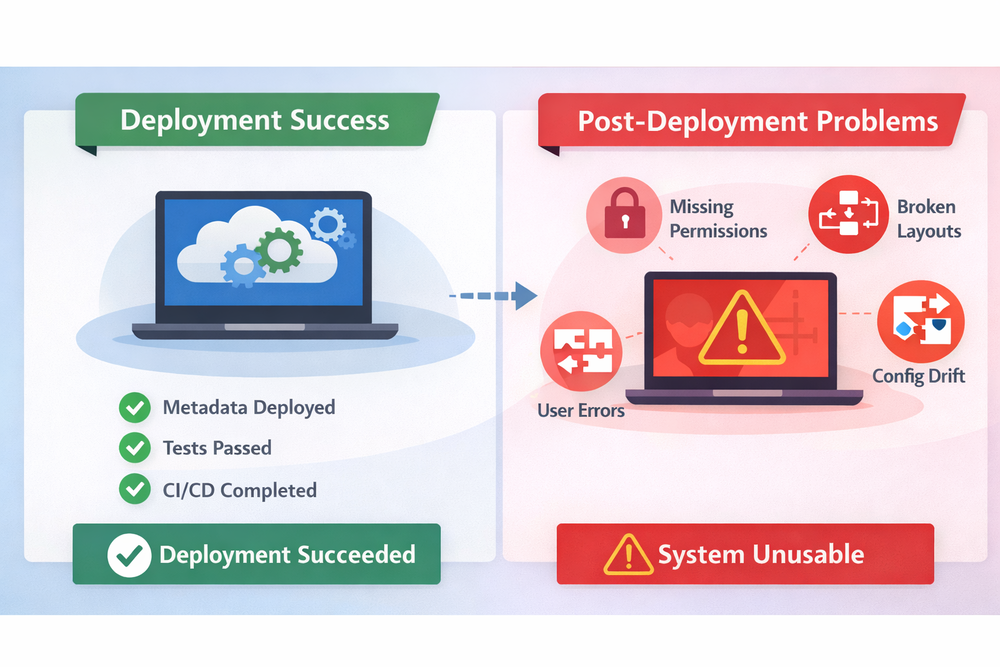
Salesforce release management challenges become critical when teams operate across multiple environments — development, QA, staging and production. At small scale, deployment feels predictable. Tests pass, CI/CD pipelines run, and metadata is delivered successfully.
However, enterprise teams quickly discover a different reality: a successful deployment does not guarantee a stable system.
Because Salesforce is a state-driven platform, behavior depends not only on code but also on permissions, data, integrations and automation timing. Therefore, most release failures do not originate from deployment errors — they appear during environment interaction after the release.
In other words, releases fail operationally, not technically.
To understand why deployment success does not equal stability, Salesforce itself distinguishes delivery and operational behavior in its release lifecycle.
Why Multi-Environment Salesforce Release Management Is Difficult
In traditional software, environments mostly differ by configuration.
In Salesforce, environments differ by history.
Each org contains:
- different record volumes
- different user access models
- different automation chains
- different connected systems
Consequently, identical metadata produces different runtime behavior.
For example, a flow tested in staging may trigger additional updates in production simply because real data relationships exist there. As a result, teams face Salesforce release management challenges even when validation and testing are correct.
The larger the organization becomes, the less predictable deployment behavior becomes.
This is also why validating deployments alone is insufficient
Environment Drift — A Core Salesforce Release Management Challenge
Over time, sandboxes diverge from production.
Not because teams make mistakes, but because business continues operating.
Meanwhile
- Automation accumulates dependencies
- Admins adjust permissions
- Support modifies data
- Integrations evolve
Therefore, staging stops representing production reality.
When a release reaches production, it activates against a different operational state than expected.
This explains the common incident:
“Everything worked in staging.”
Environment drift is not a testing problem — it is a lifecycle synchronization problem.
This is one of the reasons deployment validation and rollback alone cannot protect releases
The Post-Deployment Activation Window
After deployment finishes, the system does not instantly become stable.
Instead, a hidden transition period begins.
During this phase:
- sharing recalculates
- scheduled jobs execute
- caches rebuild
- integrations reconnect
Meanwhile, users begin working with live records.
This creates the most dangerous moment of a release.
Technically the release succeeded.
Operationally the system is still changing.
Many Salesforce release management challenges appear specifically in this activation window — before monitoring alerts and after deployment completion.
Coordination Across Teams and Systems
Modern releases are not developer-only activities.
They involve multiple roles simultaneously:
- developers deploy changes
- admins update configuration
- business users execute workflows
- external systems exchange data
Therefore timing becomes more important than deployment.
For instance, if permissions update after automation activates, workflows fail. If integrations reconnect before mapping updates, synchronization errors appear.
Consequently, release risk shifts from code quality to coordination quality.
This coordination problem is exactly why teams need operational readiness after release
Why Monitoring Cannot Solve Release Management Challenges
Monitoring tools detect failures after impact.
However, release management requires preventing impact.
By the time alerts appear:
- users are already blocked
- automation already executed incorrectly
- data inconsistencies already exist
Thus monitoring protects operation, but not activation.
Salesforce release monitoring itself is only one part of the lifecycle
How Mature Teams Handle Salesforce Release Management Challenges
Experienced organizations treat releases as staged operational transitions rather than single events.
They introduce controlled activation:
- First, allow the platform to stabilize
- Next, verify real workflows
- Then, expand user access gradually
- Finally, rely on monitoring
As a result, they reduce uncertainty dramatically.
Because the goal is not deployment success — it is uninterrupted business activity.
Where ZuppIO Fits in the Release Lifecycle
Traditional DevOps tools ensure metadata delivery.
Monitoring ensures operational awareness.
However, a gap exists between them — activation readiness.
ZuppIO operates in this specific phase.
It allows teams to:
- coordinate post-release operational actions
- validate behavior before full user exposure
- detect unexpected runtime reactions early
- confirm production readiness
Therefore teams address Salesforce release management challenges proactively instead of reactively.
ZuppIO does not replace CI/CD or monitoring.
Instead, it connects delivery and operation into a continuous lifecycle.
Operational Readiness as the Missing Layer
The release lifecycle actually contains three stages:
Delivery → Activation → Operation
Most teams manage the first and the last.
However, the middle stage determines stability.
Once activation becomes controlled, releases stop being risky events and become predictable processes.
Conclusion
A deployment moves metadata.
A release changes system behavior.
Salesforce release management challenges emerge from the difference between those two realities.
Organizations that scale environments cannot rely solely on testing or monitoring. Instead, they must manage the activation phase where production becomes real.
Mature teams no longer measure success by deployment completion.
They measure success by the absence of disruption.
Because the best release is the one users never notice.
What are Salesforce release management challenges?
They are operational risks that appear when changes move across multiple environments. Even successful deployments may fail due to permissions, data state, automation timing and integrations.
Why do releases fail after successful deployment?
Because deployment validates metadata structure, while production depends on runtime behavior, real users and real data conditions.
Why are multi-environment teams more affected?
Each environment evolves differently over time. As a result, production behavior diverges from testing behavior, creating unexpected activation issues.
Can monitoring prevent release failures?
No. Monitoring detects problems after impact. Release management requires preventing impact during activation.
How does ZuppIO help?
ZuppIO helps teams validate operational readiness, coordinate activation and detect runtime issues before they affect users.