
How to Implement Salesforce Release Monitoring in Production
Salesforce release monitoring is the process of verifying that a deployment is operationally ready in real production conditions after release.
A deployment can succeed technically and still fail operationally. Salesforce validates deployment integrity and test execution, but it cannot guarantee real user workflows in production conditions.
In real environments, data volume, permissions, integrations, and automation execution create behavior that cannot be simulated in sandboxes. That is why high-maturity teams perform release verification after deployment — not just deployment validation before it.
If you are new to release processes, first review Salesforce deployment validation. Monitoring starts where validation ends.
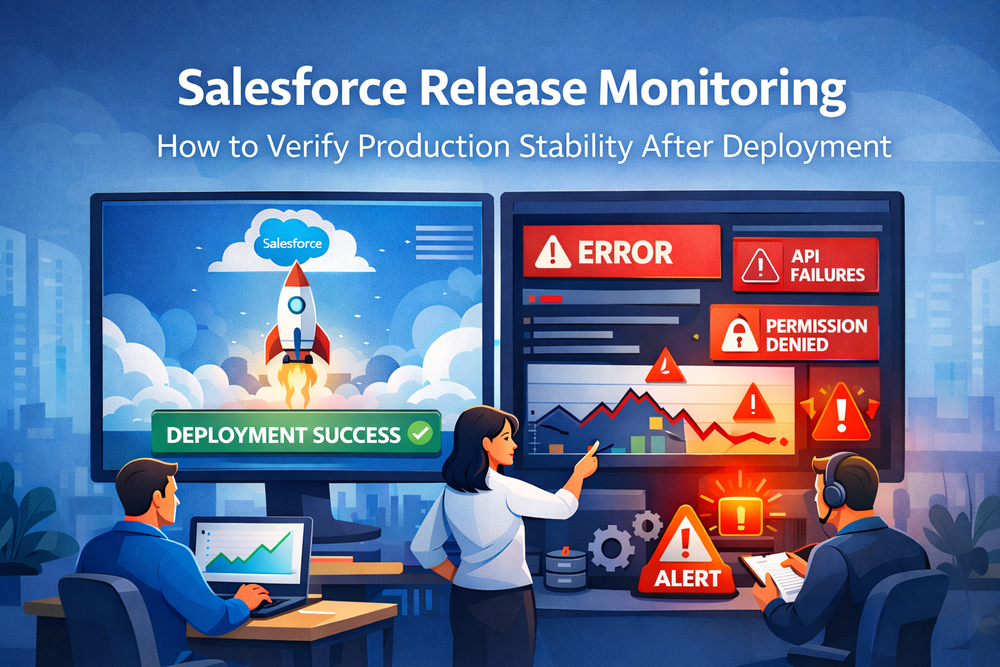
Why Monitoring Is Required After Deployment
Salesforce reports deployment status through deployment tools such as Change Sets, DevOps Center, and the Metadata API, but none of them confirm real operational behavior.
A deployment confirms that metadata can exist in the org.
It does not confirm the business can operate.
Typical post-release failures include:
accessibility
automation execution
business process continuity
integration reliability
UI usability
Users may lose access to objects, flows may stop processing records, integrations may reject payloads, or layouts may hide required fields. Technically the release succeeded — operationally it failed.
The Release Monitoring Timeline
Post-deployment verification begins immediately after deployment and continues until operational readiness is confirmed.
The first minutes verify permissions and UI behavior. Shortly after, automation and integrations start processing real events. Later, async jobs, recalculations, and scheduled processes execute.
Many issues appear only after real usage begins. A release therefore becomes safe only after operational checks confirm business continuity.
What Should Be Monitored After a Salesforce Release
Effective monitoring verifies business behavior and release state.
User access must remain intact so teams can create, edit, and process records without errors.
Automation execution must continue across flows, triggers, and scheduled jobs.
Business processes must complete end-to-end without manual intervention.
External integrations must respond correctly to production traffic through the Salesforce REST API.
Background processing must complete without stuck jobs via Apex Jobs monitoring.
The UI must remain usable, with layouts and visibility rules behaving as expected.
These checks confirm operational readiness rather than technical validity.
Common Monitoring Mistakes
Teams often believe deployment success equals release success. That assumption causes production incidents.
Teams review logs but do not validate real business workflows.
Teams verify metadata but not user behavior.
Teams rely on manual smoke testing instead of repeatable verification.
Teams react to user tickets instead of detecting issues early.
Without defined verification scenarios, organizations depend on users to test production.
Automating Release Verification
Manual monitoring does not scale. Modern teams automate operational checks after deployment.
ZuppIO automatically executes predefined post-deployment verification checks after a release. Instead of watching dashboards, teams run repeatable operational scenarios that confirm real system readiness.
ZuppIO validates business-critical scenarios by running automated operational checks after deployment, including permission validation, configuration alignment, and workflow execution across multiple orgs.
This allows teams to confirm production readiness before users encounter problems and supports safer rollback decisions using a deployment rollback strategy.
Conclusion
Salesforce deployments validate metadata.
Salesforce release monitoring validates operational readiness.
Organizations that skip post-deployment verification rely on users as testers. Organizations that verify releases ensure stable operations.
Reliable Salesforce delivery is not achieved when deployment finishes — it is achieved when the business can safely operate.
To implement operational release verification in your environment, start with ZuppIO .
What is Salesforce release monitoring?
Salesforce release monitoring is the process of verifying system behavior after a deployment reaches production.
Instead of only checking whether metadata deployed successfully, teams confirm that real business operations still function correctly — including permissions, automation, integrations, and user workflows.
It helps detect silent failures that traditional CI/CD pipelines cannot identify.
Why do deployments fail after being successful?
A deployment can succeed technically but fail functionally.
Metadata may compile and deploy correctly while business logic breaks due to permission changes, automation order, missing data dependencies, or integration mismatches.
Most production incidents happen after release because pipelines validate structure, not real behavior.
What should be monitored after a Salesforce deployment?
Teams should monitor user access, automation execution, integrations, UI behavior, and background jobs.
The goal is to confirm that the system behaves the same way for users as it did before the release.
Monitoring business outcomes is more important than monitoring deployment logs.
How is release monitoring different from testing?
Testing happens before deployment in controlled environments, while release monitoring verifies behavior in real production conditions.
Sandboxes cannot fully reproduce real data volume, integrations, user roles, and automation timing.
Monitoring acts as the final safety layer after deployment.
Can Salesforce monitor releases automatically?
Salesforce provides logs and monitoring tools, but they are technical and reactive.
Teams still need automated validation scenarios that simulate real business actions to detect functional failures quickly.
Modern release operations platforms automate these checks across multiple orgs.
How does ZuppIO help with release monitoring?
ZuppIO automates post-deployment validation by executing predefined operational checks immediately after release.
It verifies permissions, automation execution, integrations, and configuration alignment across environments and subscriber orgs.
This allows teams to detect production issues early and decide whether a rollback is necessary before users notice problems.