
Salesforce Post-Deployment Automation: Complete Guide (2026)
Salesforce post deployment automation is becoming essential for modern teams.
Many organizations invest in CI/CD and deployment tools expecting reliable releases. However, most issues appear after deployment, when automation executes, integrations reconnect, and users interact with real data.
Deployment delivers changes — but it does not guarantee correct system behavior in production.
This is why post-deployment automation in Salesforce is becoming a critical part of modern DevOps.
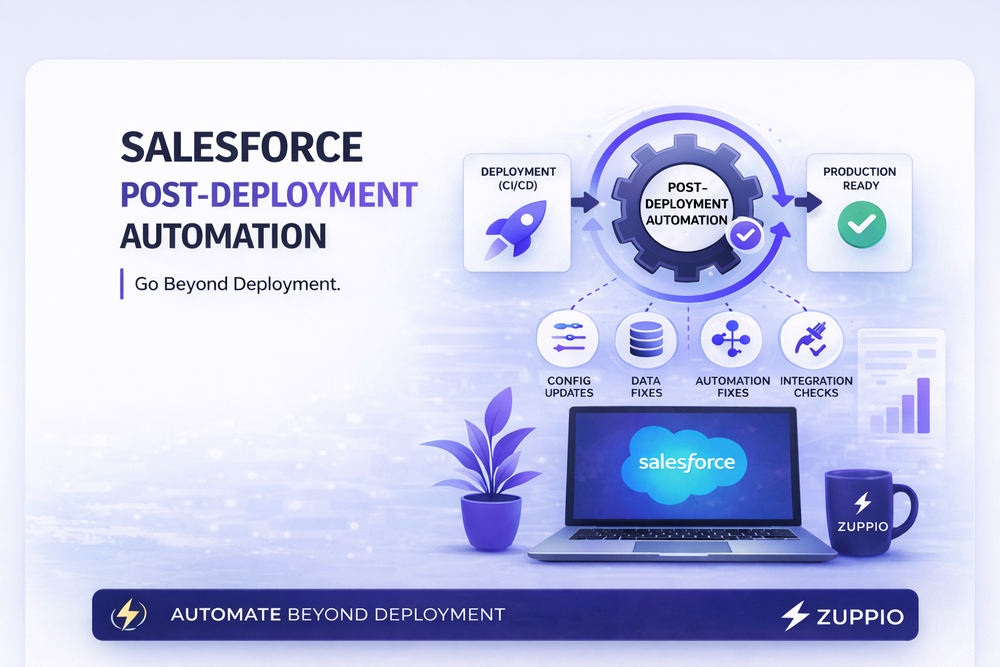
What Is Salesforce Post Deployment Automation
Salesforce post deployment automation refers to automating processes that happen after a deployment is completed.
These include:
- configuration updates
- data alignment
- automation adjustments
- validation and rollback
Unlike CI/CD, which focuses on metadata delivery, this layer focuses on system behavior after release.
Why Post-Deployment Automation Matters
Many issues arise because deployment does not fully reflect production reality.
After deployment:
- automation executes updated logic
- integrations process real data
- users trigger edge cases
- environments behave differently
To understand this deeper, see
what happens after deployment in Salesforce
What CI/CD Does — and What It Doesn’t
CI/CD improves delivery processes.
It helps with:
- version control
- automated deployments
- metadata validation
As explained in the Salesforce DevOps Center overview, DevOps tools manage how changes move across environments.
However, CI/CD does not fully:
- validate runtime behavior
- control automation execution
- ensure data consistency
- manage post-release changes
Key insight:
CI/CD ensures deployment success — not production reliability.
For more context, see
why Salesforce deployment challenges still exist
Common Post-Deployment Tasks in Salesforce
Teams still perform many tasks manually after deployment.
Configuration Updates After Deployment
- updating layouts
- adjusting permissions
- aligning picklists
Data Adjustments in Production
- fixing records
- migrating data
- aligning values with new logic
Automation Adjustments
- updating flows
- adjusting triggers
- fixing logic issues
Integration Checks
- validating APIs
- updating mappings
- fixing broken connections
These tasks are repetitive and difficult to scale.
Why Manual Post-Deployment Work Doesn’t Scale
As systems grow, manual processes become inefficient.
Teams face:
- inconsistent environments
- human errors
- slower releases
- increased production risks
This becomes critical in multi-org environments.
Automating Post-Deployment Processes in Salesforce
Effective automation focuses on:
Automating Configuration and Updates
- applying changes across orgs
- updating settings and structures
Maintaining Environment Consistency
- synchronizing configurations
- reducing drift
Executing Changes at Scale
- running scripts
- applying fixes across environments
Validating and Controlling Changes
- verifying updates
- reverting changes when needed
These capabilities improve reliability and reduce risks.
How ZuppIO Supports Post-Deployment Automation
ZuppIO helps teams manage post-deployment processes by adding automation and control after deployment.
It allows teams to:
- automate repetitive post-deployment updates
- synchronize configurations across orgs
- execute changes across environments
- validate changes and safely revert updates
For example:
- post-install updates across multiple orgs
- execute anonymous Apex in Salesforce
- validation and revert in Salesforce
ZuppIO complements CI/CD by extending automation beyond deployment.
The Future of Salesforce DevOps
Salesforce DevOps is evolving beyond deployment.
Modern teams are focusing on:
- full lifecycle automation
- post-release control
- visibility into system behavior
As explained in Salesforce architecture fundamentals, behavior depends on runtime conditions — not just metadata.
Key insight:
Post-deployment automation is the missing layer in Salesforce DevOps.
Final Thoughts
Deployment is only part of the process.
Teams need to manage what happens after release.
By introducing automation after deployment, teams can:
- reduce risks
- improve consistency
- scale more effectively
The goal is not just to deploy changes — but to ensure they work in production.
What is Salesforce post deployment automation?
Salesforce post deployment automation refers to automating processes that occur after deployment, such as configuration updates, data alignment, and validation.
Why is post-deployment automation important in Salesforce?
It ensures that the system behaves correctly after deployment by managing automation, data, and integrations in production environments.
Does CI/CD cover post-deployment processes in Salesforce?
No, CI/CD focuses on delivering changes but does not fully manage post-deployment behavior or system consistency.
What tasks can be automated after deployment?
Tasks include configuration updates, data fixes, automation adjustments, integration checks, and validation processes.
How can teams implement post-deployment automation?
Teams can use tools like ZuppIO to automate updates, synchronize environments, and manage changes after deployment.